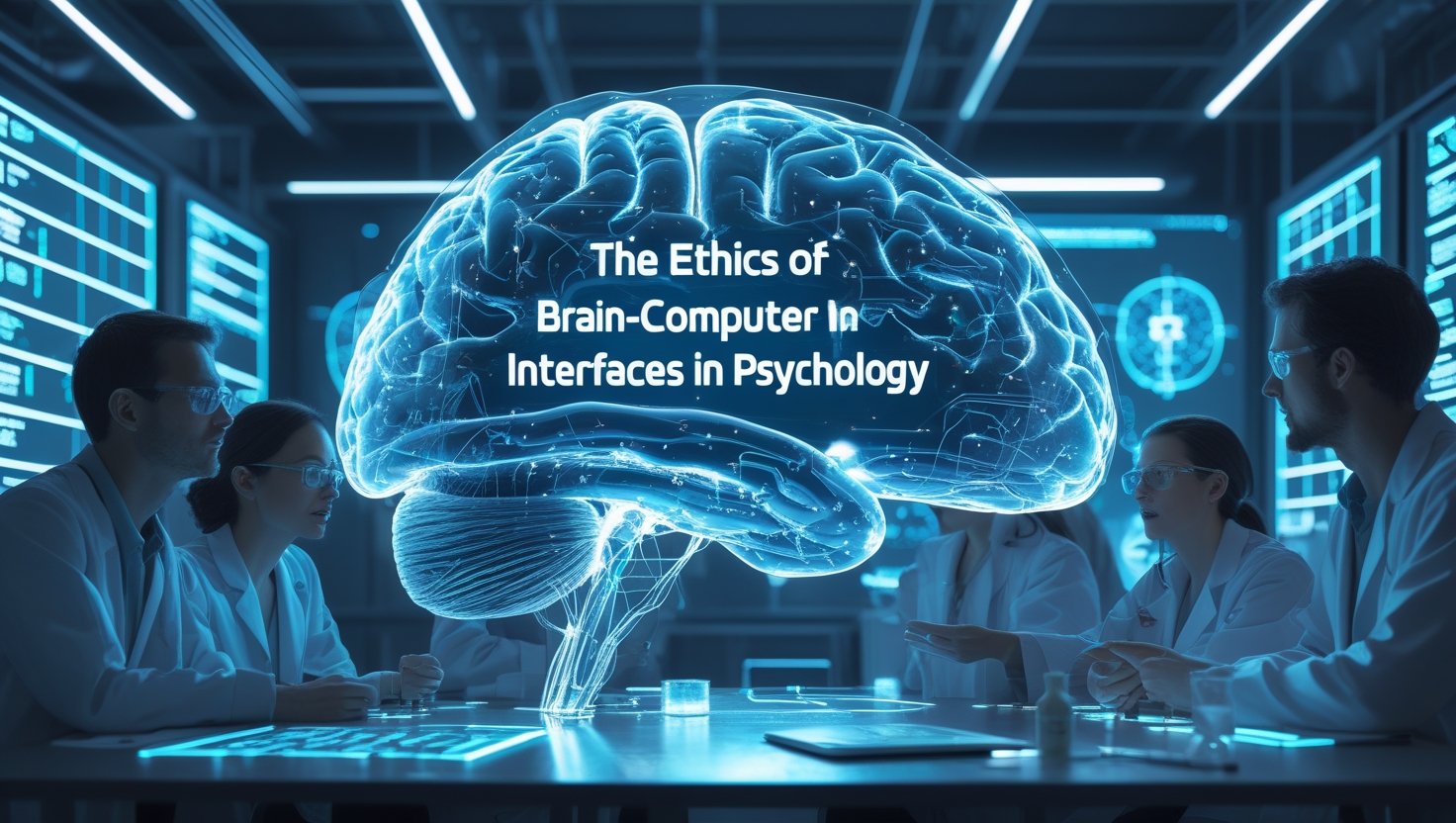
In today’s era, Brain-Computer Interfaces, i.e., BCIs, have become a revolutionary technology that creates a direct connection between the human brain and the computer. This system reads brain signals and converts them into digital commands. It was earlier used in the medical field, like helping paralyzed patients, but now this technology is being used in psychological research and therapy as well. As its use is being expanded, ethical concerns are also being expanded. People have started thinking that if someone’s mind can be controlled or monitored through a machine, then it can also be misused in sensitive fields like psychology.
Where personal emotions and thoughts are involved. And where BCIs have a direct relation to psychological and behavioral issues, it becomes very important to ensure ethical use of tools like BCIs. The purpose of this introduction is to explain that BCIs are not just technological tools; rather, they touch a person’s mental freedom and personal integrity, and hence it is necessary to draw responsible and ethical boundaries for them. In this blog, we will explore all the ethical aspects that are related to the psychological use of BCIs so that we can understand how these new tools can be used for the benefit of humans and what things we should avoid.
Understanding How BCIs Interact with the Human Mind
The real work of Brain-Computer Interfaces, i.e., BCIs, is that they read the signals from the human brain and make those signals understandable by the computer. Just as we generate a thought, our brain creates electrical signals, and BCI picks up those signals through sensors. Then these signals are decoded by software and are converted into a command. In this way, any device can be controlled just by thinking without hands or tongue. These things are not only beneficial for people with physical disabilities but can also bring a lot of new things to psychological research. But when a system starts understanding the thoughts and intentions of a human being, then ethical concerns arise.
Psychology involves complex aspects of emotions, memory, stress, and behaviour. And
If BCI can reach these things,
Will that information remain safe?
Will this interaction not be based on human thinking?
If someone’s mind is being analyzed by a machine, can they think freely? These questions are important because BCI technology is not just an input-output device; rather, it can enter the human mental system and understand it and perhaps control it. And for this reason, the detail of this interaction is important to understand and ethically assess me.
Consent and Autonomy in Neuroethology:
The first ethical issue in the use of BCIs is whether the user or patient has full knowledge about how their brain data will be recorded and how it will be used. The concept of informed consent becomes very important here. In psychology, when you have access to the thoughts and feelings of a patient, you have to take full authority over him. But BCI technology is so new and complex that it is difficult for common people to understand what things can be revealed from their brain signals.
Do they know that their subconscious behavior can also be analyzed?
The meaning of autonomy is that every human being is free to make their own decisions.
You are free, but when your brain is connected to any external device, this freedom can be at risk. If someone else has data about your brain, they can try to influence or manipulate you. Or your information can be used for some other purpose without your consent. That is why transparency and complete explanation are necessary in neurotechnology so that the user can make really informed decisions. This is not just a legal obligation but also an ethical responsibility that every individual should understand how their brain activity is being used and whether he is affected by it or not, if this system is implemented without clear consent. So that would be against the concept of psychological autonomy.
Privacy and the Risk of Mental Surveillance:
When a technology gets access to your mind, privacy is not just limited to physical or digital information; your thoughts, intentions, and inner world also become vulnerable. Your brain activity data is recorded through BCIs, and if this data is passed on to a third party, they can understand your identity, preferences, fears, and reactions. This is called mental surveillance, and it can become a very dangerous phenomenon. Imagine if an organization or government monitors the raw thoughts of your mind.
Where will your freedom be if someone knows what you think about a particular thing?
Or if you’re unconscious memory has gone through some trauma, then that person gets the tools to manipulate you. This becomes the ultimate breach of privacy. This is why in psychology, where mental health and therapy work, the ethical use of BCI becomes even more important. The trust between therapist and client breaks down when the patient does not know where the information coming out of his brain is going and how it is being stored. Therefore, the policy of collection, encryption, and usage of brain data must be very transparent and secure, so that people can talk openly about their mental state and feel in control of their thoughts.
Enhancing vs Controlling – Where Do We Draw the Line?
One of the great promises of BCIs is that they can enhance human capabilities, such as improving decision making, improving memory, or helping in emotional regulation. But there is a thin ethical line at this point:
What is the difference between enhancement and control?
If a device makes you better, will it not also push you in a certain direction?
If a signal is given to calm your emotions, is it a genuine emotional experience or artificially induced?
If a device can predict your behavior, can it also control it?
This dilemma is important in psychology because mental freedom should not be compromised. Power enhancement should mean that you can make your decisions better, but if the device starts taking decisions, then it comes under the category of control. While designing the technology, it should be kept in mind that the power should remain with the user and the machine should only do the work of support. If this balance is lost, then BCIs will not only be helpful tools, but they will become such mediums that can control human behavior and thinking, and this cannot be considered correct in any way from an ethical point of view.
Conclusion:
The last thing is to understand that BCI technology is not a far-fetched dream but a real and fast-moving development that will have a deep impact on psychology. Through this technology, we can explore new ways to understand the mind, but without strong ethical frameworks, it can cause more harm than benefit. We must create guidelines that handle issues such as consent, autonomy, privacy, and control in clear and enforceable terms. Along with legal policies, ethical education is also important so that scientists, developers, and psychologists all understand that their work is not just limited to innovation but also to protecting human dignity.
They also must do this. In the future, when this technology becomes common, not only its use but also its misuse will be possible. Therefore, it is very important to prepare now and define clear lines. We are getting so close to the human mind that if we do not neglect it, technology can take away both our freedom and identity. The goal of this blog is to start a meaningful dialogue so that we can use this amazing technology within ethical boundaries, and the relationship between man and machine should be based on mutual respect.